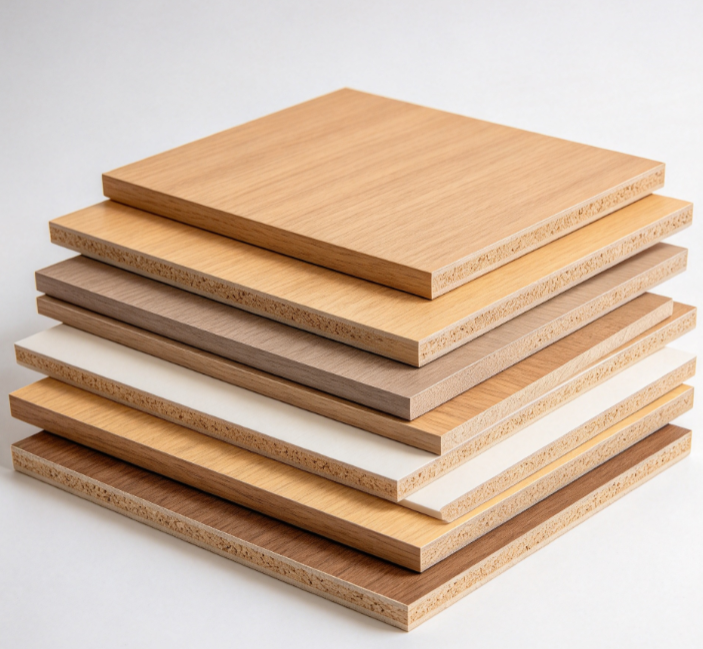
Artificial Boards: A Reliable Material Solution for Modern Furniture and Interior Manufacturing
Introduction: Why Artificial Boards Are Becoming Essential in Modern Design
The furniture and interior manufacturing industries are experiencing a major shift in material selection. As designers, manufacturers, and consumers pay more attention to consistency, sustainability, and production efficiency, traditional solid wood is no longer the only preferred choice.
This change has increased the demand for Artificial Boards, which have become an important material category for modern furniture production, interior decoration, and customized home solutions.
Unlike natural wood, artificial boards are engineered materials produced by processing wood fibers, particles, or veneers through controlled manufacturing processes. They offer advantages such as stable dimensions, efficient processing, flexible surface finishing, and better material utilization.
For furniture manufacturers, choosing the right board material is not simply about cost. It directly affects product appearance, durability, production efficiency, and customer satisfaction.
As global furniture production continues to develop toward customization and large-scale manufacturing, artificial boards are playing an increasingly important role in meeting diverse design and production requirements.
Table of Contents
· What Are Artificial Boards?
· Why Artificial Boards Are Widely Used in Furniture Manufacturing
· Main Types of Artificial Boards and Their Applications
· Key Advantages of Artificial Boards
· Manufacturing Quality Factors Buyers Should Consider
· Artificial Boards vs Natural Wood Comparison
· Global Market Trends Driving Artificial Board Demand
· How IMIXHOME Supports Modern Furniture Material Solutions
· Frequently Asked Questions
What Are Artificial Boards?Artificial Boards are engineered wood-based panels manufactured by combining wood materials with adhesives or other processing technologies to create stable and functional panel products.
Instead of directly using solid timber, artificial boards make use of wood fibers, chips, particles, or thin wood layers to create materials with controlled properties.
Common types include:
· Medium Density Fiberboard (MDF)
· Particle Board
· Plywood
· Decorative panels
· Other engineered wood panels
These materials are widely used in:
· Home furniture
· Office furniture
· Kitchen cabinets
· Wardrobes
· Interior wall panels
· Commercial decoration projects
The popularity of artificial boards comes from their ability to provide consistent quality and efficient manufacturing performance.
For furniture producers, consistency is often one of the biggest challenges when working with natural materials. Artificial boards help reduce variations caused by differences in wood species, moisture content, and natural structure.
Why Artificial Boards Are Widely Used in Furniture ManufacturingThe global furniture industry has become increasingly focused on efficiency, customization, and material optimization.
Manufacturers need materials that can support:
· Large-scale production
· Complex designs
· Surface decoration
· Precise cutting and assembly
Artificial boards meet these requirements through engineered performance.
Better Dimensional Stability
Natural wood can expand or shrink due to changes in humidity and temperature.
Artificial boards are manufactured under controlled conditions, which helps improve dimensional stability.
This is especially important for:
· Cabinet doors
· Flat-pack furniture
· Large panel structures
· Customized furniture systems
Stable dimensions help manufacturers achieve better assembly accuracy and reduce production issues.
Efficient Processing Performance
Modern furniture production often requires:
· CNC cutting
· Edge banding
· Drilling
· Surface finishing
Artificial boards are designed to work efficiently with these manufacturing processes.
Their consistent structure allows manufacturers to achieve:
· Faster production cycles
· Reduced material waste
· More predictable processing results
Flexible Surface Design
One reason artificial boards are popular in interior applications is their ability to support different surface treatments.
Options include:
· Wood grain finishes
· Decorative laminates
· Painted surfaces
· Veneer coverings
This gives designers more freedom to create different styles while maintaining production efficiency.
Main Types of Artificial Boards and Their ApplicationsDifferent artificial board types offer different performance characteristics.
Choosing the right board depends on the application, design requirements, and expected performance.
Board Type | Main Characteristics | Common Applications |
MDF Boards | Smooth surface, uniform structure, easy machining | Furniture panels, cabinets, decorative components |
Particle Boards | Cost-effective, lightweight, suitable for mass production | Residential furniture, office furniture |
Plywood | Strong layered structure and good durability | High-strength furniture, construction-related applications |
Decorative Boards | Attractive surface appearance and design flexibility | Interior decoration and finished furniture |
Each type has its own advantages, and professional manufacturers usually select materials according to product requirements rather than using one material for every application.
Key Advantages of Artificial BoardsImproved Material Utilization
One major advantage of artificial boards is efficient use of wood resources.
By processing smaller wood materials into engineered panels, manufacturers can reduce dependence on large solid timber pieces and improve overall material utilization.
This is becoming increasingly important as industries worldwide focus on more responsible resource management.
Consistent Quality
For furniture manufacturers, consistency is critical.
Artificial boards provide more uniform:
· Thickness
· Density
· Surface quality
· Structural performance
This helps manufacturers maintain stable product quality across large production volumes.
Cost Efficiency
Compared with many solid wood options, artificial boards can provide more predictable material costs.
This makes them suitable for:
· Large furniture production
· Commercial projects
· Customized home furniture
Design Flexibility
Artificial boards support various design approaches.
Manufacturers can combine different surfaces, colors, textures, and finishing techniques to create diverse furniture styles.
Manufacturing Quality Factors Buyers Should ConsiderWhen purchasing Artificial Boards, buyers should look beyond basic appearance.
Several factors influence final product performance.
Board Density and Structure
A stable internal structure affects:
· Screw holding ability
· Durability
· Processing performance
Surface Quality
The surface determines:
· Visual appearance
· Finishing results
· Customer experience
High-quality surfaces are especially important for visible furniture components.
Thickness Accuracy
Consistent thickness helps improve:
· Assembly precision
· Product stability
· Manufacturing efficiency
Quality Factor | Why It Matters | Impact on Final Products |
Density consistency | Improves structural stability | Better durability |
Surface smoothness | Supports finishing processes | Better appearance |
Thickness accuracy | Improves assembly compatibility | Higher production efficiency |
Material stability | Reduces deformation risks | Longer product lifespan |
Both artificial boards and natural wood have their own advantages. The best choice depends on the application.
Comparison Factor | Artificial Boards | Natural Wood |
Material Consistency | High consistency through engineered production | Natural variation between pieces |
Processing Efficiency | Easy for large-scale manufacturing | Requires more material selection |
Design Flexibility | Supports various surface finishes | Depends on wood characteristics |
Resource Utilization | Efficient use of wood materials | Requires larger timber resources |
Application Range | Furniture and interior manufacturing | Premium furniture and traditional applications |
For many modern furniture manufacturers, artificial boards provide a practical balance between performance, design flexibility, and production efficiency.
Global Market Trends Driving Artificial Board DemandThe demand for engineered wood products continues to grow as global furniture and interior industries expand.
Several trends are influencing the market:
Growth of Customized Furniture
Consumers increasingly prefer personalized furniture solutions.
This requires materials that can support:
· Flexible designs
· Efficient production
· Consistent quality
Artificial boards are well suited for customized furniture manufacturing because they can be processed into different shapes and sizes.
Increasing Focus on Sustainable Materials
The furniture industry is paying more attention to responsible material use.
Engineered wood products help improve resource efficiency by utilizing wood materials that may not be suitable for traditional solid wood production.
Expansion of Global Furniture Manufacturing
Furniture production continues to develop across multiple regions, including Asia, Europe, and North America.
Manufacturers need reliable materials that can support both domestic and international supply chains.
How IMIXHOME Supports Modern Furniture Material SolutionsIMIXHOME focuses on providing furniture and interior material solutions designed to meet modern manufacturing and design requirements.
With attention to material quality, product consistency, and application flexibility, the company supports customers looking for reliable Artificial Boards and related furniture solutions.
For furniture manufacturers, designers, and project developers, selecting the right material supplier can help improve production efficiency, maintain product quality, and create better finished products.
Frequently Asked Questions1. What are Artificial Boards mainly used for?
Artificial Boards are widely used in furniture manufacturing, cabinets, wardrobes, interior decoration, office furniture, and customized home projects.
2. What are the most common types of Artificial Boards?
The most common types include MDF, particle boards, plywood, and decorative engineered panels.
3. Are Artificial Boards suitable for customized furniture?
Yes. Artificial boards are widely used in customized furniture because they provide stable dimensions, easy processing, and flexible surface design options.
4. How should buyers choose the right Artificial Boards?
Buyers should consider application requirements, surface quality, thickness accuracy, structural performance, and supplier manufacturing capability.
ConclusionAs furniture manufacturing continues to move toward customization, efficiency, and better resource utilization, Artificial Boards are becoming an increasingly important material solution.
With stable performance, flexible processing capabilities, and diverse design possibilities, artificial boards help manufacturers create furniture products that meet modern market demands.
For companies looking for reliable furniture material solutions, working with an experienced supplier can provide better control over product quality, production efficiency, and long-term project success.
Related Articles